
As businesses grow or face uncertainty, they often need executive expertise without hiring another full-time leader. Understanding the difference between a Fractional CXO vs Interim CXO vs Consultant can help companies choose the right level of leadership, accountability and specialist support.
These roles solve different business problems. The right choice depends on your organisation’s growth stage, urgency and desired outcomes.
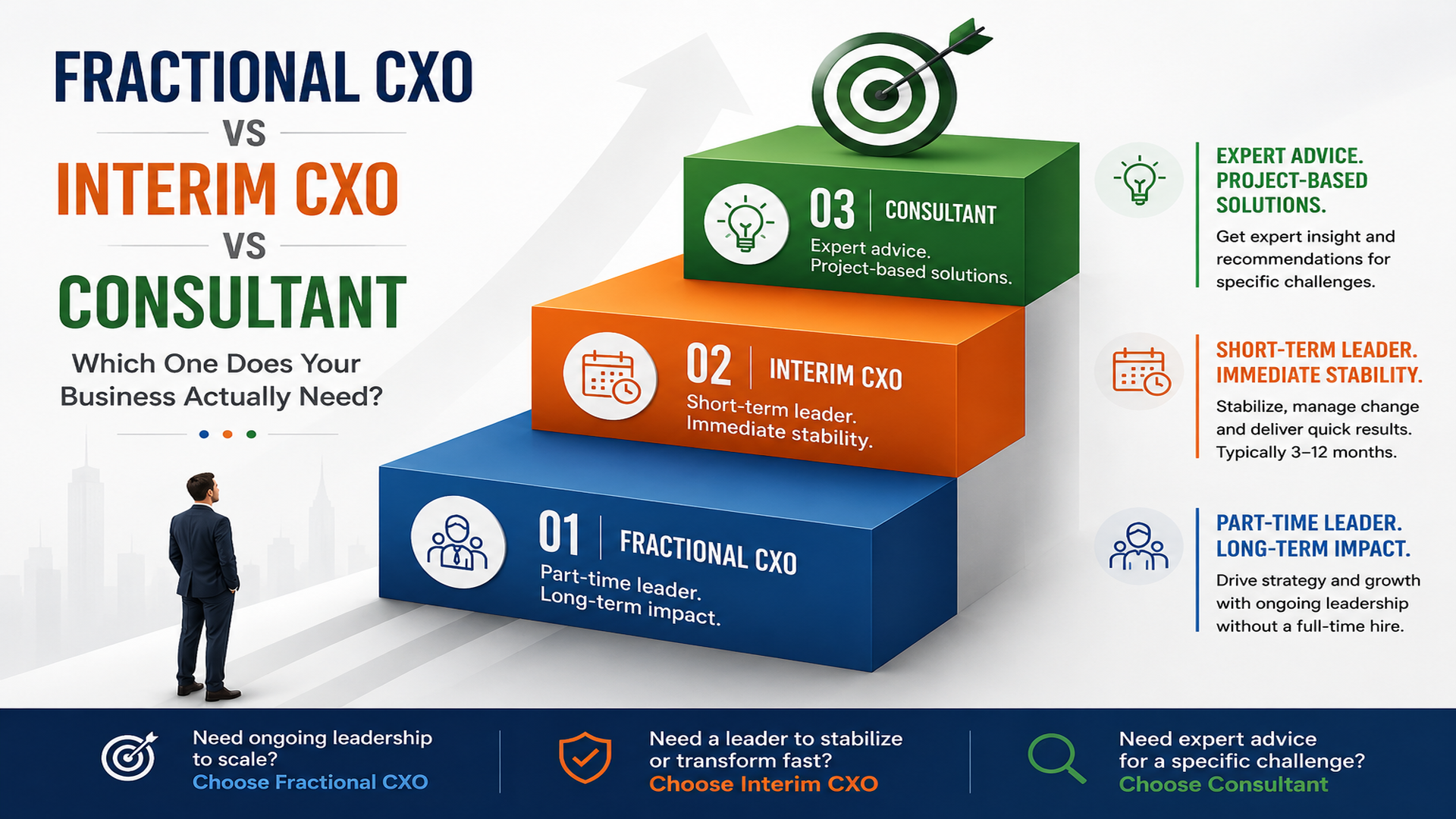
A Fractional CXO provides part-time, ongoing executive leadership. An Interim CXO takes temporary operational responsibility during a transition or leadership gap. A business consultant offers specialist advice for a defined challenge or project.
What Is a Fractional CXO?
A Fractional CXO is an experienced executive who works with a company on a flexible or part-time basis. The role may include a Fractional CEO, CFO, CMO, CTO or COO.
Unlike an external advisor, a Fractional CXO becomes part of the leadership team. They help define strategy, guide internal teams and remain accountable for business outcomes.
This model is suitable when a business needs long-term strategic direction, support during growth or digital transformation, leadership for a specific function, or executive expertise without the cost of a full-time appointment.
For startups and SMEs, fractional leadership can close capability gaps while the organisation scales. For example, a growing SME preparing for international expansion may appoint a Fractional CFO to improve financial planning and investor readiness.
What Is an Interim CXO?
An Interim CXO is a senior executive appointed for a fixed period to manage a transition, crisis or leadership vacancy. They usually work closer to a full-time schedule and take direct operational responsibility.
Companies may hire an Interim CXO after the sudden departure of a senior leader, during restructuring, before a merger or while recruiting a permanent executive. Their priority is to stabilise operations and deliver results within a defined timeframe.
An Interim CXO is the right choice when your business needs immediate executive leadership, turnaround management, temporary operational control or a bridge until a permanent CXO is appointed.
For instance, if a company’s CFO resigns unexpectedly, an Interim CFO can oversee reporting, budgeting and stakeholder communication.
What Is a Business Consultant?
A business consultant provides specialist analysis, recommendations and external expertise for a clearly defined business challenge. Consultants may support strategy, technology, finance, marketing, operations or organisational change.
Unlike Fractional and Interim CXOs, consultants generally do not own day-to-day leadership. They assess the situation, recommend solutions and may support implementation, while accountability remains with the internal management team.
A consultant is ideal when your business needs an independent assessment, market research, process improvement, specialist knowledge or support for a specific project.
Fractional CXO vs Interim CXO vs Consultant: How to Choose
The key differences are ownership, duration and accountability. Choose a Fractional CXO when you need sustained leadership on a flexible basis. Select an Interim CXO when executive responsibility must be transferred immediately. Engage a business consultant when the challenge is clearly defined and your internal team can lead implementation.
How an Executive CXO Forum Can Help
A trusted Executive CXO Forum can help founders, SME leaders and senior executives evaluate leadership models through peer discussions, case studies and expert perspectives.
Platforms such as the Swiss CXO Forum create opportunities for leaders to exchange insights on business growth, transformation, innovation and executive decision-making. Through events and cross-industry knowledge sharing, organisations can determine whether they require fractional leadership, an interim executive or specialist consulting support.