
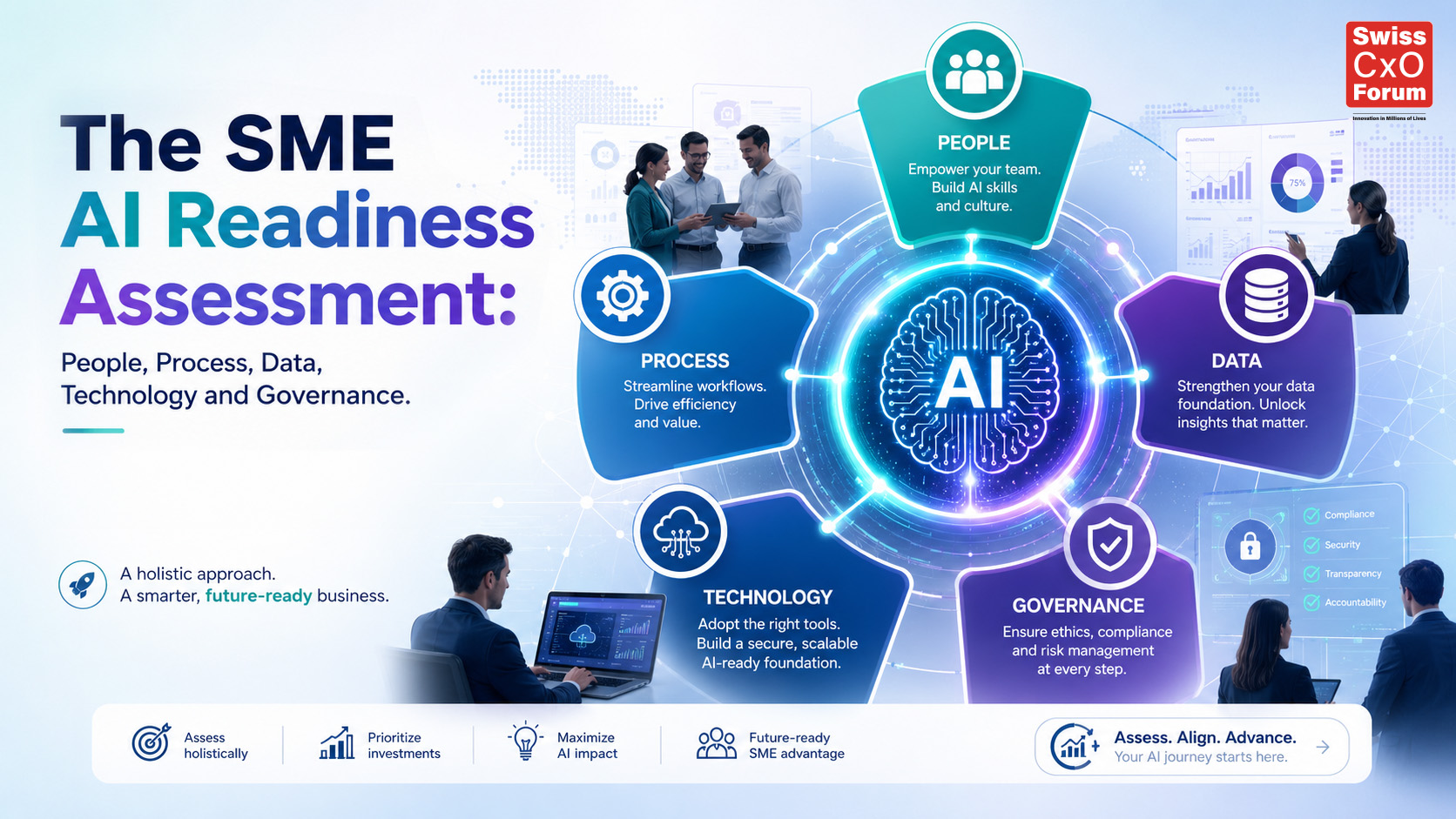
Artificial intelligence is becoming a practical growth tool for small and medium-sized enterprises. From automating routine work to improving forecasting, customer service and decision-making, AI can help SMEs compete more effectively. However, purchasing an AI tool does not automatically make a business AI-ready.
An SME AI readiness assessment evaluates whether an organisation has the capabilities, structure and safeguards required to adopt AI successfully. A useful assessment should examine five connected dimensions: people, process, data, technology and governance.
1. People: Building Skills and Leadership Alignment
AI adoption begins with people. Business leaders must understand where AI can create value, while employees need the confidence and skills to use it responsibly. An assessment should review leadership commitment, internal AI awareness, technical expertise and employee readiness for change.
SMEs do not always need a large in-house AI team. They do, however, need clear ownership, practical training and access to trusted external expertise. Upskilling employees also reduces resistance and helps teams recognise where human judgement must remain part of the workflow.
2. Process: Identifying the Right AI Use Cases
AI should solve a defined business problem rather than become a technology experiment. The process dimension examines how work is currently performed, where bottlenecks exist and which activities could benefit from automation or intelligent support.
Suitable starting points may include document processing, customer enquiries, sales forecasting, quality control, inventory planning or management reporting. SMEs should prioritise use cases according to business value, implementation effort, risk and measurable outcomes. A focused pilot with clear success indicators is usually more effective than attempting enterprise-wide transformation immediately.
3. Data: Creating a Reliable Foundation
AI systems depend on accessible, relevant and reliable data. An AI readiness assessment should evaluate how data is collected, stored, protected and shared across the organisation.
Common challenges include incomplete records, inconsistent formats, duplicated information and isolated systems. Before scaling AI, SMEs should establish data ownership, quality standards, access controls and secure data-management practices. Strong data foundations improve the reliability of AI outputs and help decision-makers trust the results.
4. Technology: Assessing Infrastructure and Integration
Technology readiness covers the systems, platforms and infrastructure required to support AI. This includes cloud capabilities, cybersecurity, APIs, software compatibility, computing resources and integration with existing ERP, CRM or operational tools.
The goal is not to adopt the most advanced solution. SMEs should select scalable technology that fits their needs, budget and digital maturity. Vendor reliability, implementation support, security and long-term operating costs should be considered before investment.
5. Governance: Enabling Responsible AI Adoption
Governance ensures that AI is used safely, transparently and accountably. SMEs should define who approves AI use cases, which data may be used, how outputs are reviewed and how risks are monitored.
An effective governance approach should address privacy, cybersecurity, bias, intellectual property, regulatory requirements and third-party tools. Human oversight is especially important when AI influences customers, employees, financial decisions or business strategy.
Turning Readiness into an AI Roadmap
An SME AI readiness assessment provides more than a maturity score. It identifies capability gaps, prioritises practical use cases and creates a phased roadmap for responsible AI adoption. By aligning people, process, data, technology and governance, SMEs can move from isolated experimentation to measurable and sustainable business value.
Ready to understand your organisation’s AI maturity and next steps? Contact Swiss CxO Forum to explore expert guidance, peer learning and practical support for responsible digital transformation.