
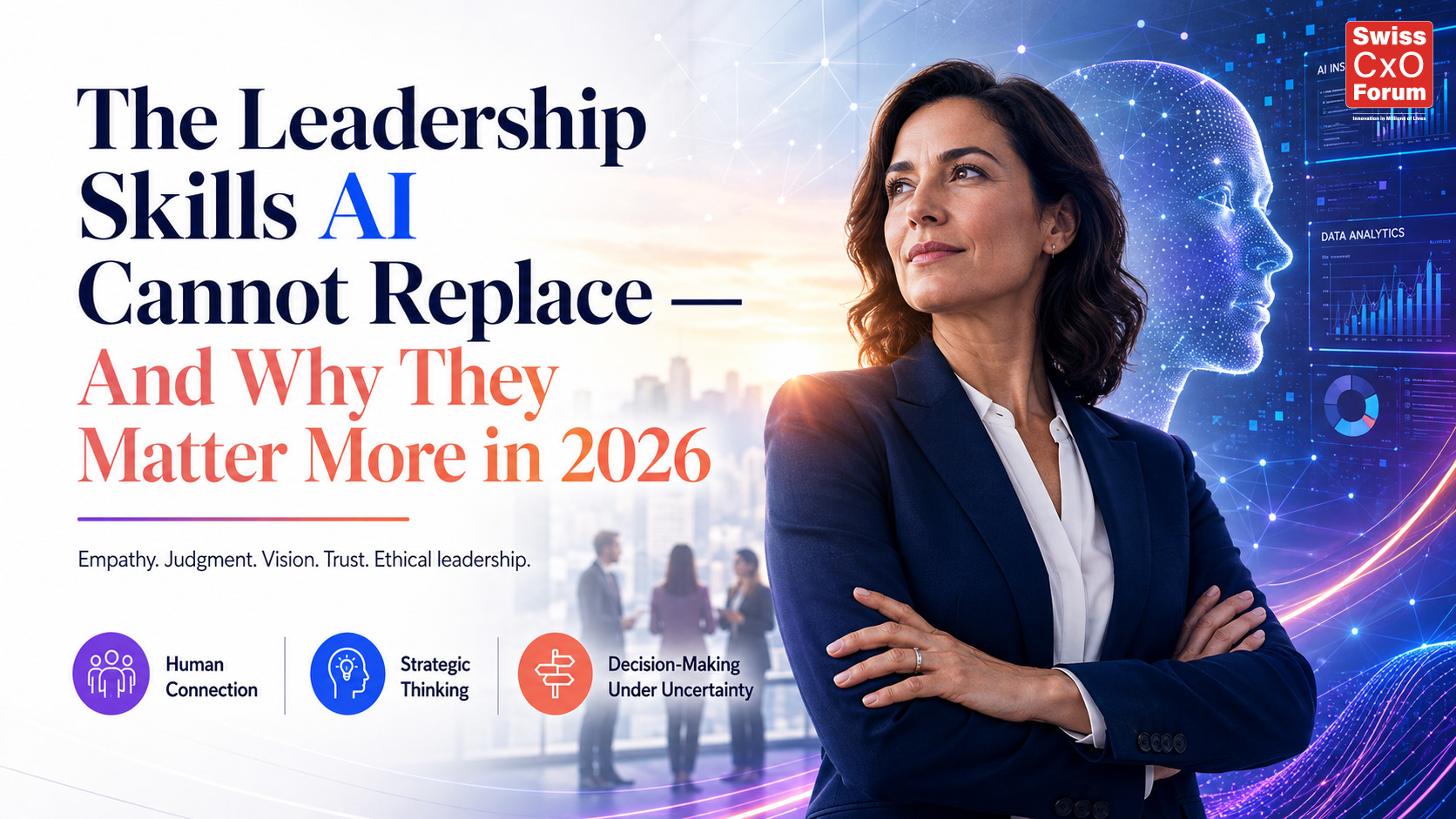
Artificial Intelligence is transforming the way organisations operate, make decisions, and create business value. From generative AI assistants to automated workflows and predictive analytics, technology is becoming an essential capability for modern enterprises.
However, as AI continues to advance, one important question remains:
Which leadership skills will remain uniquely human in an AI-driven world?
The answer is clear: the future of leadership will not be defined by competing with AI, but by developing the human capabilities that technology cannot replicate.
In 2026, successful leaders will need more than digital awareness. They will need strategic vision, emotional intelligence, ethical judgement, adaptability, and the ability to inspire people through continuous transformation.
Why Leadership Matters More in the AI Era
AI can process massive amounts of information, identify patterns, and support faster decision-making. However, leadership is not only about analysing data. It is about understanding people, creating alignment, managing uncertainty, and making decisions that reflect organisational values.
AI transformation is ultimately a leadership challenge, not only a technology challenge. Organisations that successfully adopt AI will be those where executives combine technology adoption with strong leadership, governance, and workforce readiness.
1. Strategic Vision and Business Thinking
AI can generate insights, but it cannot define the future direction of an organisation.
Leaders must understand how emerging technologies connect with business goals, customer expectations, and long-term growth strategies.
Future-ready executives need to answer critical questions:
- Where can AI create meaningful business value?
- Which processes should be automated?
- How can organisations balance technology with human expertise?
Strategic thinking will remain one of the most valuable leadership skills because it transforms AI capabilities into real business outcomes.
2. Emotional Intelligence and Human Connection
One of the most important leadership skills AI cannot replace is emotional intelligence.
As organisations introduce AI-driven changes, employees need leaders who can communicate clearly, address concerns, and create confidence during periods of uncertainty.
Empathetic leaders understand that transformation is not only about systems and processes — it is about people.
The ability to build trust, encourage collaboration, and support teams through change will become even more important as AI reshapes the workplace.
3. Ethical Decision-Making and Responsible AI Leadership
The growing adoption of AI brings new responsibilities around transparency, privacy, accountability, and responsible innovation.
Leaders must ensure that AI is used in a way that creates sustainable value while maintaining trust among employees, customers, and stakeholders.
Responsible AI leadership requires executives to understand not only what AI can achieve, but also what decisions should remain guided by human judgement.
Ethical leadership will become a key differentiator for organisations building long-term trust in the AI era.
4. Adaptability and Continuous Learning
Technology is evolving faster than ever. Skills, processes, and business models that work today may require transformation tomorrow.
Successful leaders in 2026 will embrace continuous learning and encourage their organisations to develop future-ready capabilities.
Adaptability allows executives to respond to market changes, adopt emerging technologies, and create cultures where innovation can grow.
5. Inspiring People Through Transformation
AI can recommend actions, but it cannot inspire people to believe in a vision.
Leadership requires storytelling, communication, motivation, and the ability to bring people together around a shared purpose.
The strongest leaders of the future will not simply implement AI tools. They will create environments where humans and technology work together to achieve greater impact.
The Future of Leadership: Human Intelligence + Artificial Intelligence
The question is not whether AI will replace leaders.
The real question is:
How will leaders evolve alongside AI?
The executives who succeed in 2026 will be those who combine artificial intelligence with uniquely human strengths — creativity, empathy, strategic thinking, and responsible decision-making.
At Swiss CXO Forum, we believe the future of leadership depends on empowering executives with knowledge, collaboration, and forward-thinking perspectives. As a Swiss community platform connecting C-level executives, innovators, and transformation leaders, Swiss CXO Forum supports organisations in navigating digital transformation, AI adoption, and future-ready leadership.
To explore how your organisation can prepare for the AI-driven future and strengthen leadership capabilities, contact Swiss CXO Forum today and connect with a community focused on responsible innovation, strategic growth, and the future of business.
AI can enhance intelligence. But leadership gives intelligence direction.