
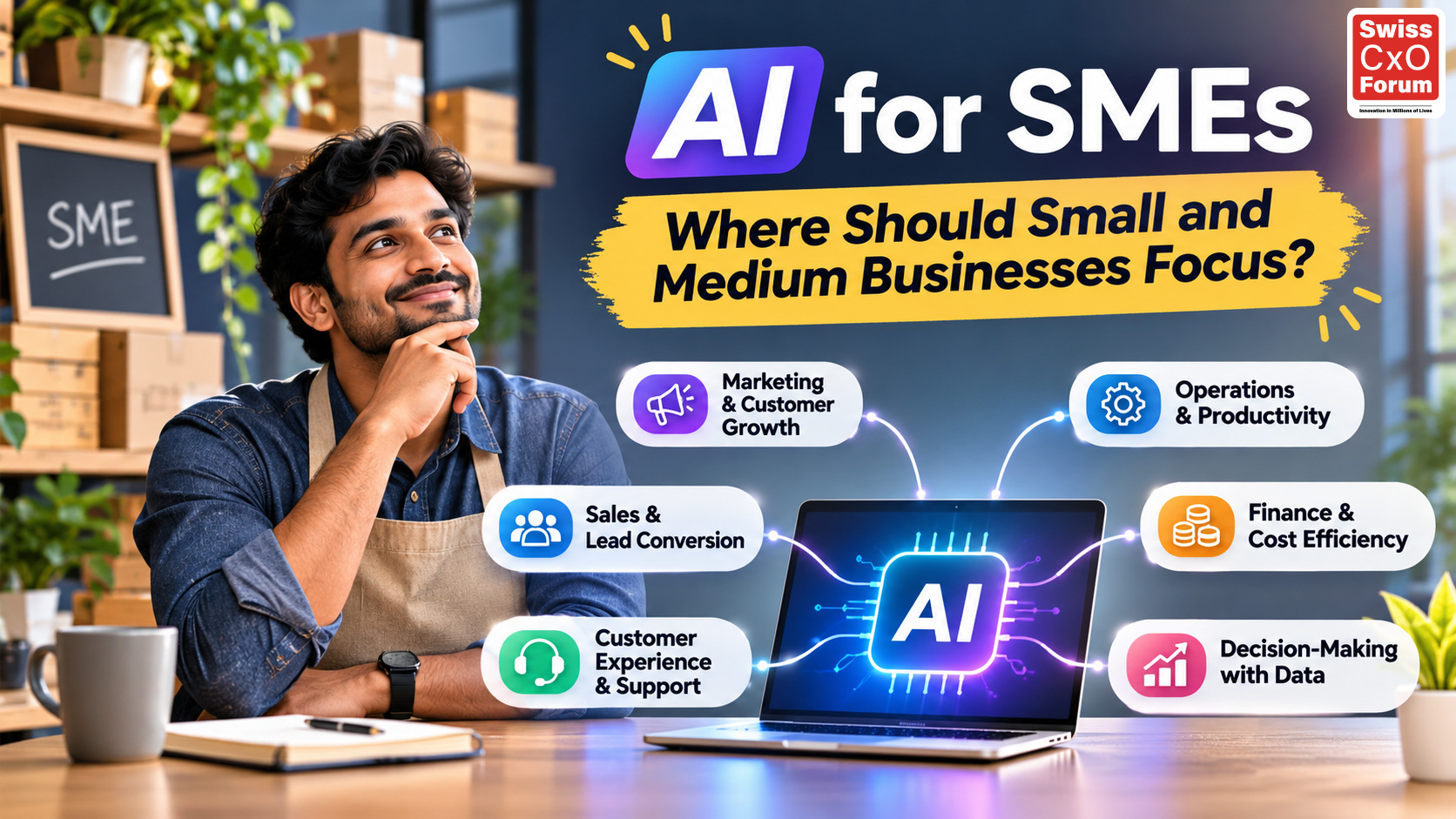
Artificial Intelligence (AI) is transforming how businesses operate, compete, and make decisions. For small and medium-sized enterprises (SMEs), AI offers opportunities to improve efficiency, reduce costs, and accelerate innovation.
However, adopting AI does not mean investing in expensive technologies or transforming every business process overnight.
For SMEs, successful AI adoption begins with identifying the right business challenges, building essential capabilities, and creating measurable value.
Why Should SMEs Consider AI Adoption?
Small and medium-sized businesses often face limited resources, increasing operational costs, and competitive pressure. AI can help address these challenges by improving productivity and supporting better decision-making.
Practical applications include automating administrative tasks, analysing customer behaviour, improving demand forecasting, and optimising operational workflows.
For Swiss SMEs, AI can also support innovation and competitiveness in industries such as manufacturing, healthcare, finance, and professional services.
The objective should not be adopting AI faster than competitors but implementing it where it genuinely improves business performance.
1. Start With Business Priorities, Not Technology
Before exploring AI solutions, SME leaders should identify their most pressing operational challenges.
Consider questions such as:
- Which processes consume unnecessary time and resources?
- Where do employees experience repetitive workloads?
- What prevents faster or more informed decisions?
- Which customer experiences need improvement?
For example, a manufacturing company might explore predictive maintenance, while a professional services firm could use AI to streamline document processing.
The right starting point is a business problem with a clear, measurable outcome.
2. Evaluate Data Readiness
AI depends on reliable, accessible, and relevant data. Businesses should assess existing information systems before introducing AI-powered solutions.
This includes reviewing customer databases, operational records, financial information, and reporting processes.
Poor data quality can undermine AI performance and lead to inaccurate conclusions.
SMEs should also consider data protection, cybersecurity, and compliance with applicable Swiss regulations.
A strong data foundation helps organisations implement AI responsibly and sustainably.
3. Begin With Small, High-Impact AI Projects
Rather than launching large-scale transformation initiatives, SMEs should prioritise manageable AI pilot projects.
Potential starting points include customer enquiry automation, sales forecasting, inventory optimisation, document management, and internal knowledge assistants.
Each initiative should have a defined objective, responsible owner, and measurable success criteria.
Starting small enables businesses to evaluate outcomes, manage risks, and build organisational confidence before expanding implementation.
4. Invest in People and AI Skills
Technology alone cannot deliver successful AI transformation.
Employees need the knowledge and confidence to work effectively with AI-enabled processes.
SME leaders should encourage AI awareness, practical training, and cross-functional collaboration.
Equally important is maintaining human oversight, particularly when AI supports sensitive or business-critical decisions.
Developing internal capabilities ensures AI becomes an organisational advantage rather than an isolated technology investment.
5. Create a Practical AI Roadmap
A structured AI roadmap helps SMEs connect technology investments with long-term business objectives.
The roadmap should establish priorities, implementation responsibilities, data requirements, budgets, governance measures, and performance indicators.
Businesses can measure success through reduced processing time, improved accuracy, higher productivity, or better customer satisfaction.
Experienced executive guidance can help SMEs make informed technology decisions, avoid unnecessary complexity, and align AI initiatives with business strategy.
How Can Swiss CxO Forum Support SMEs?
The Swiss CxO Forum supports Swiss SMEs through experienced executive perspectives, strategic mentoring, knowledge sharing, and transformation guidance. Its CxO-as-a-Support initiative helps organisations navigate business challenges and identify practical opportunities for innovation.
Leading Digital & Innovation Transformation+1
By connecting business leaders with relevant expertise, the Forum encourages responsible AI adoption, stronger decision-making, and sustainable business development.
Conclusion: Start With Value, Scale With Confidence
AI adoption for SMEs does not require a complete technological overhaul. It requires clear priorities, reliable data, capable teams, and a structured implementation approach.
The most important question is not “Which AI tool should we adopt?” but “Which business problem should we solve first?”
For SMEs, meaningful AI transformation begins with the right decisions, not the most advanced technology.
Ready to explore how AI can create meaningful value for your business?
Connect with Swiss CxO Forum to access experienced executive guidance and explore practical approaches to AI adoption and digital transformation.